Most people still think going off-grid means either lugging around a noisy, fuel-chugging generator or roughing it with flat phones and cold tea. But the Jackery Explorer 1000 flips that idea on its head. It’s become a bit of a legend around UK campsites and coastal vans, and after a few stormy nights trying to keep lights on and batteries full, I can see why.
This isn’t just about power – it’s about keeping things simple, quiet, and reliable when you’re out chasing views, not sockets. So, if you’re eyeing a solid off-grid setup without the fuss, here’s what the Jackery 1000 is really like, from someone who’s used it in the wild.
What Is the Jackery Explorer 1000 – and Why Do Campers Eye It?
Big question: Why not just bring loads of batteries or a tangle of power banks? Well, I learned the hard way in Northumberland – found myself with six half-charged gadgets and a cold breakfast because my “trusty” power bank couldn’t cut it with a coolbox.
The Jackery Explorer 1000 is not a noisy generator, and it’s nothing like those awkward car battery jumpers. It’s a proper portable power station – a big, rechargeable battery box with multiple outlets. Designed to run everything from tiny torches to portable fridges and laptops, it’s meant for wild camping, festival weekends, and even emergency blackouts at home.
Plenty claim their kit can power your whole camping setup, but few do it well or conveniently. The Jackery Explorer 1000 is right in that “goldilocks” zone: enough power for real gear, not so massive it needs a trolley, and way more user-friendly than a camping generator. No fumes, no noise – just power you can rely on.
Key Features
If you’re new to power stations, specs can be gibberish. Here’s what actually matters for us folk outdoors:
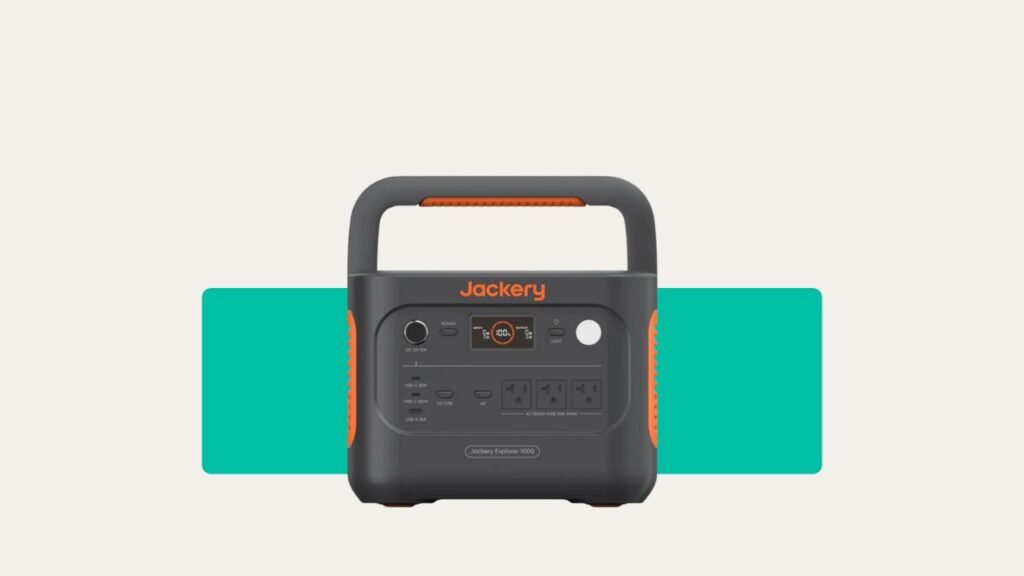
Battery Size: Most versions pack 1002 watt-hours (Wh); some newer models hit 1265Wh. In plain English: it can run a 50W fridge for about 17-20 hours. Or a laptop for days.
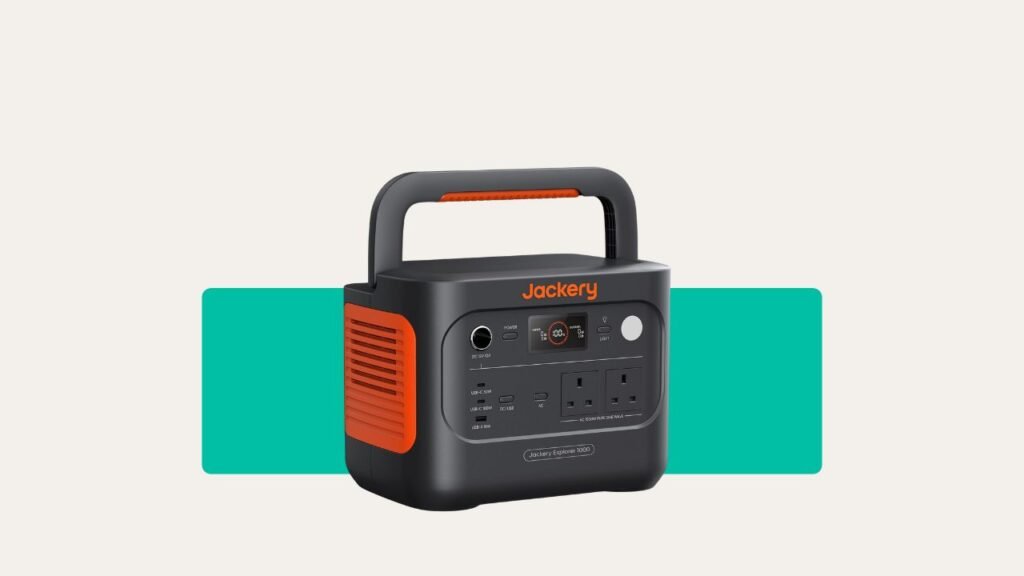
Outlets for All Gear: Three UK AC sockets (proper three-pin, pure sine wave – so safe for laptops), a DC car port, and plenty of USB – two USB-C, two USB-A. Laptops, drones, cameras, phones, fans, lights, CPAPs – all covered.
Charging Methods: Plug it into the wall, the car, or solar panels. That matters when you’re days from the nearest mains hookup, or stuck on a rainy field.
Weight & Size: About 10kg. Not a featherweight, but one person can carry it. Think carry-on suitcase, not car battery.
Weather Resistance: Classic Explorer 1000 isn’t rated waterproof, but the Pro version is IP68 – built to shrug off downpours and dusty fields.
Durability: Feels solid, with proper shock resistance on newer models. I’ve lugged it through damp ferns and a Cornish bramble or two – it’s held up.
Tip: Never leave it out overnight in proper British weather unless it’s the Pro version. It’ll survive a splash, but a soggy weekend at Brecon can test any kit.
Power Output and Real Efficiency
Specs are one thing; performance is the decider. Here’s what you can actually expect on a proper UK trip.
- AC Output: 1000W continuous, peaks up to 2000W. That means you can run multiple gadgets at once, including things with motors (like a blender or electric coolbox), without tripping.
- Efficiency: If you use about 34 watts constant, you’ll get roughly 49% of the rated battery (some loss converting DC to AC, normal for all stations). Bump up to a 380W appliance, efficiency jumps to about 86% — not bad at all.
- Standby Loss: Leave it for three months – in my test, 82% of the charge was still there. That’s solid, especially if you stash it for those “just-in-case” scenarios like winter storms.
- If you want more: Some folks get caught out because the Jackery (like most power stations) pulls a little extra energy to run its inverter and display. So your fridge gets most of the juice, but the box itself needs a sip too. No free ride in physics.
Where’s it a let-down? The 10kg weight is fair, but if you’re hiking up Ben Nevis for a summit camp, you’ll notice it. In a van or car, not an issue.
Jackery Explorer 1000 in the Wild: Stress-Tested in UK Conditions
So, does this thing actually keep up when you’re camping on Dartmoor, or does it quit when you desperately need a brew?
A real trip example: Three nights wild camping in Yorkshire. Explorer 1000 ran a small fridge (28W draw), two phones, one laptop, and occasional fairy lights. After two days, I still had over 30% charge left – didn’t rush for the car charger. Kept the tent civilised while the wind howled and rain tried to soak everything.
Did it power everything? Not quite. Standard kettles – forget it, not a chance, unless it’s a low-wattage travel version. But it’ll do a sandwich toaster, a fan, a CPAP machine, phone charging for a family, and even an electric blanket (if you’re cheeky and pick a low-powered one).
It also came in as a lifesaver during a power cut in January. Kept the WIFI, lights, and radio running until the grid came back. No generator noise. No tripping over extension leads.
Charging the Jackery: Solar vs UK Mains
Charging speed separates the “nice-to-have” from the “seriously useful” in portable power. Here’s my take.
- Wall Charging: 0-100% in about 6.5 to 7 hours from a mains socket. Acceptable if you top it up before a weekend. Annoying on longer road trips unless you plan ahead.
- Car Charging: Similar timeframe, maybe a tad slower. Handy when you’re on the move, less good if you’re static.
- Solar Charging: With one 100W solar panel, you’re looking at 16-17 hours for a full top-up. Add a second panel? That’s about 8 hours in peak sunlight, but let’s be real, UK sun isn’t Arizona. Expect actual solar charging to be patchy unless you’re careful with panel angle and cloud dodging.
Only want to top up, not charge from zero, while you use gadgets? Solar’s great. But you won’t get unlimited power on gloomy Dales mornings. I set up two panels near Loch Lomond. Got about half a tank back after an entire sunny Scottish day. Moral: bring a cable, don’t bank on the sun.
Pros, Cons, and All the Honest Gripes
Here’s the unfiltered camper’s summary.
Who Should Actually Buy the Jackery Explorer 1000?
This box is perfect for wild campers, van owners, or anyone who wants a fuss-free power solution and doesn’t want to haul a generator. If you’re using a CPAP, running a fridge, charging multiple devices, or just want backup for blackouts, it’s a solid bet.
If you only want to charge phones and tablets, it’s probably overkill. Grab a lighter, cheaper power bank. Lightweight backpackers will rightly say “too heavy” – fair.
But for families camping in dodgy weather, festival goers, or anyone fed up with dead torches on a wet Lake District midnight, it’s a superb balance of muscle and simplicity.
Pricing and Value
Let’s talk pounds and pence. At full UK retail, the Jackery Explorer 1000 ain’t pocket change. Expect to see prices hovering around £1,000 – sometimes a bit less in spring or Black Friday sales.
Is it worth it? If you need real, reliable power for days – and hate faffing with gas generators – yes. You’re looking at roughly 84p a watt-hour, which is as competitive as most other big-name stations. But honestly, wait for deals unless you’re desperate or prepping for a storm.
Check out Jackery UK directly or at major retailers. I’ve seen solid savings during limited-time offers – every penny helps after buying new camping gear.
Final Thoughts: Is the Jackery Explorer 1000 Worth Packing?
Let’s not wrap things in marketing. The Jackery Explorer 1000 is a proper step up for anyone who wants full-featured, no-nonsense portable power in the UK.
Will it stand up to an endless Scottish downpour? Get the Pro if rain is your main worry, or always store it inside. Can it run your entire camp like Blackpool Illuminations? Not quite, but it covers the essentials and then some.
I’ve relied on mine through shivering May nights on the North York Moors and sudden October blackouts. Knowing you can get a brew, keep a fridge cold, or run a CPAP – without petrol fumes or drama – makes it worth the investment and the boot space.
My closing advice: If you camp in all weather, travel with family, or just like tech that works, the Explorer 1000 is a smart choice. Watch for sales, pair with a second solar panel, and don’t sweat over the odd slow top-up.
For lighter trips or short overnights, save your money and go smaller. But if you want to “set and forget” your camp power, this is your new best mate. It’s earned a permanent space alongside my battered Trangia and mud-stained boots.