Most people stroll through the Peak District and barely give those old stones a second glance. But the truth is that boundary stones can hold more stories and surprises than you might imagine, especially in Derbyshire’s Sites of Meaning.
Each stone along this walk isn’t just a marker; it’s a moment, a message, a memory set in stone. If you love a walk that gives you more than just fresh air – something with a bit of mystery, grit, and soul – this one’s worth lacing up for.
What Are “Sites of Meaning” and Why Should You Care?
The Sites of Meaning project began back in 2000, thanks to some stubborn, clever folk in Middleton and Smerrill parish. Instead of throwing a forgettable party for the millennium, the whole community marked all seventeen entrances to their ancient parish with boundary stones, each inscribed and properly crafted. Now, these stones make a full circuit and tell more about the area than most glossy tourist leaflets ever will.
Think of it as an outdoor storybook, just rugged, and sometimes hidden in the long grass. Walking the route connects you with the land and the small adventures that come from finding each marker.
Why the Millennium Stones?
The big myth? That countryside boundary stones have always just popped up as random markers. Not here. For the millennium, the villagers got creative: they set out to put meaning back into their boundaries.

Seventeen tailored stones were set up, each with an inscription tied to its spot. Some are serious, some witty, all speak of the community and the wild limestone country.
It’s a history lesson in every footstep, and no two stones are the same.
The Full Map: All 17 Sites of Meaning Markers
1. Village Stone – Marker 0
You’ll find the Village Stone in the heart of Middleton village (DE45 1LS), tucked into the nature garden beside the children’s playground. It’s the only unnumbered marker and acts as the centrepiece of the entire Sites of Meaning project.
This stone is shaped like a viewfinder, with seventeen lines of inscription spiralling outwards. Each line loosely points toward one of the seventeen boundary markers surrounding the village. The phrases range from poetic to philosophical. Lines like “Live as if you’ll die tomorrow – farm as if you will live forever” and “To see a world in a grain of sand” offer a reflective glimpse into the wider themes of the trail.
If you’re new to the project, this is a great place to start. It gives you a sense of what’s to come and ties everything together.
2. Roughwood Seat – Marker 1
From the Village Stone, head up Weadow Lane. A short walk leads you to the Roughwood Seat, carved directly into the dry-stone wall on the right-hand side of the road.
This marker doubles as a resting spot and features a thoughtful inscription: “In quietness and in confidence shall be your strength.” The quote was chosen by a local resident who originally encountered the words through a family connection to Middleton’s historic Bateman family.
As part of a steep walking route, it feels fitting that the stone invites you to pause, not just physically, but mentally. The view across the fields completes the scene.
3. Roughwood Kerbs – Sites of Meaning Marker 2
Just a few steps back uphill from the seat are the Roughwood Kerbs. These stones are set into the wall and were created in collaboration with local adults and pupils from Youlgrave Primary School.
The inscription here brings a burst of youthful imagination:
“Down the dale feel the wet soggy dogs which have just come out of the river. He’s beautiful, golden, white fur, wild, free, ready to come and go as he pleases.”
It’s lively, descriptive, and captures the childlike wonder of exploring the countryside. This marker reminds us that local heritage isn’t just about history but also about the stories we pass on.
4. Bradford Bridge – Marker 3
Follow the path downhill into a wooded area, and you’ll reach Bradford Bridge – a charming old stone crossing with a bit of history and controversy. The decision to etch into its surface raised some eyebrows when the project began.
But time has done its work. Lichen now softens the inscription’s edges, blending the old with the new. The carved line from William Wordsworth reads:
“Still glides the stream, and shall forever glide; The form remains, the function never dies.”
It’s hard to imagine words more fitting for this peaceful, flowing spot. The sound of water beneath your feet makes the inscription all the more memorable.
5. Sheep Dip – Marker 4
From Bradford Bridge, continue along the riverside path, past remnants of a long-gone mill. As the track curves and you cross the river again, keep an eye out for the Sheep Dip marker, built into a low wall.
This spot was once used for washing sheep – a seasonal and social event in the farming calendar. The inscription reflects this scene with almost lyrical rhythm:
“Dip your ghosts into this hard, cold merky place – Hear their bleat in the water’s rush to escape – The foam like wool pulsates.”
There’s something both eerie and beautiful in the phrasing, and the setting adds to the atmosphere. The stone captures a lost practice and transforms it into something quietly poetic.
6. Clapper Bridge – Marker 5
To reach this marker, continue southwest from the Sheep Dip, take a left-hand path, and cross a small wooden bridge. A set of metal stairs will take you up to a wider path. Follow it east until you arrive at the old clapper bridge.
This stone is set into a restored slab of the bridge and carries a line from Alexander Pope:
“Consult the Genius of the Place in all; That tells the Waters or to rise or fall.”
Originally, the idea of altering the clapper bridge met resistance from archaeologists.
But the compromise, adding the inscription during restoration, proved a thoughtful way to blend heritage with poetry. It encourages you to pause, take in the scene, and consider how the landscape shapes everything around it.
7. Rowlow Brook – Marker 6
From the clapper bridge, continue uphill across the fields and stiles until you reach a narrow lane. Just on the right, the marker sits in the brook beneath the stone wall, though in summer it can be hidden beneath thick greenery.
There’s little backstory to this one, but its message is simple and calming:
“The peace of running water to you.” It marks the eastern edge of the parish. Standing there, with the gentle sound of water below and the breeze in the grass, the inscription speaks for itself. It’s a quiet kind of beauty, easy to miss but hard to forget once seen.
8. Over Rusden – Sites of Meaning Marker 7
Though numbered earlier, this marker is best reached after visiting Rowlow Brook. Head back to the main path and take the route opposite the lane, leading southwest and gently uphill toward a large ash tree. It’s easy to miss this one. Many walkers drift too far right. Stick to the middle.
What you’ll find is a circular arrangement of stones etched with lines from W.H. Auden’s “In Praise of Limestone”:
“But when I try to imagine a faultless love / Or the life to come, what I hear is the murmur / Of underground streams, what I see is a limestone landscape.”
It’s one of the more poetic and carefully curated markers on the route, with each word placed individually to echo the flow of the poem and the shape of the land. The result feels both thoughtful and fitting for this quiet hillside spot.
9. Smerrill – Sites of Meaning Marker 8
From Over Rusden, continue southwest along the field’s boundary to Weaddow Lane. Cross into the next field and pass the farm on your left before turning uphill. On a bend in the road, you’ll find the Smerrill stone, unmistakable in its sculptural form.
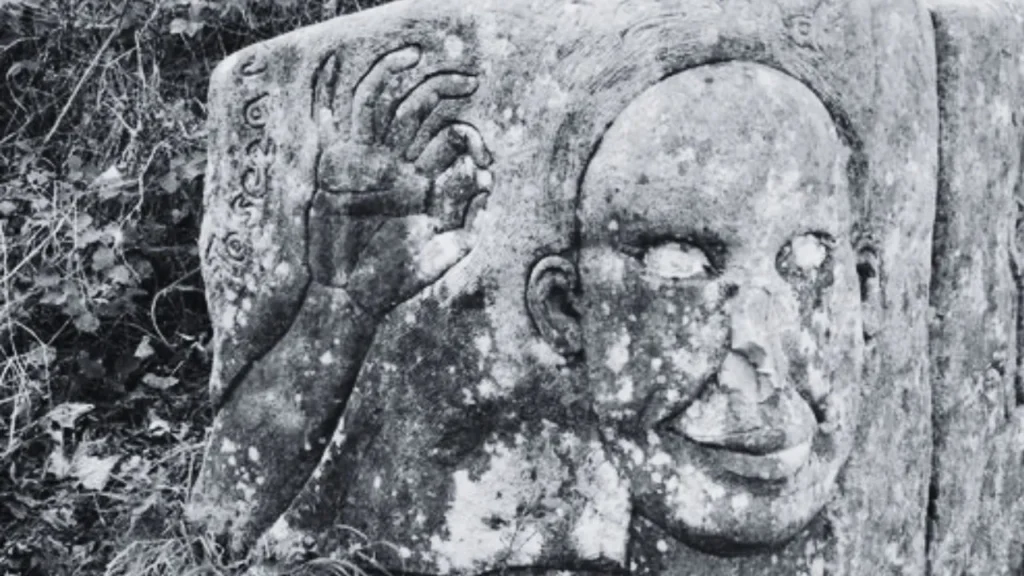
This marker stands out. Inspired by historic guide stoops, the carved stone originally featured a nose and eyes – features later damaged by vandals. Was it too bold? Too human? No one really knows. But the stone has since been restored and now looks out calmly over the landscape.
Its inscription, from William Blake, reads:
“To see a world in a grain of sand and a heaven in a wild flower, hold infinity in the palm of your hand, and eternity in an hour.”
This is one of the trail’s most visual and reflective pieces, both in its shape and its message.
10. Longdale – Marker 9
Head back down the road from Smerrill, then follow the footpath at the sharp bend uphill through two stone walls. As the valley opens ahead, take the left-hand path down into the dip where the marker sits snugly in a walled corner.
This stone came from a memory. Its proposer, Alan Burgess, had spent time trekking in Nepal and was deeply touched by both the scale of the mountains and the warmth of the people he met.
The inscription captures that feeling of connection and parting:
“We meet to create memories and depart to cherish them.”
Set in a quiet, almost hidden spot, the marker feels personal—perfect for a brief moment of reflection before moving on.
11. Balderstone – Marker 10
From Longdale, follow the path uphill until it levels out near a small wooded area. Pass through a metal gate and continue through a grassy glade – one of those peaceful, tucked-away spots that feels almost hidden.
As the glade widens, keep left and head through a gap in the wall. A short way along, you’ll reach a tall sycamore tree with the Balderstone set neatly into the wall opposite.
Sculptor Jamie Vans chose this location deliberately. It’s a quiet green lane, far from cars, and full of gentle charm. The quote he carved, “The road up and the road down are one and the same” is from Heraclitus. It fits well here. You’re walking through a valley where paths loop, dip, and climb, all blending into one journey.
The stone itself is carved from local Hoptonwood, chosen to echo the dry-stone walls around it. A subtle piece, but perfectly at home.
12. Friden Bends – Marker 11
Continue on to the road. If traffic is light, you can walk directly along it; otherwise, there’s a field-edge detour that rejoins the route higher up. Once on the road, head down, round a right-hand bend, and up again to a left-hand bend. The Friden Bends stone is tucked between two trees at the start of that bend.
Poet David Fine approached this marker with a precise, layered vision. His aim was to create a milestone that could be read three ways – coming in, going out, and as a complete poem in itself. It reads like clipped phrases or marching calls:
“left – right, quick – march, past – enough, earth – to spy, and beat – the bounds, breathless – death, ere – owns.”
Each pair of words has its rhythm, and together they seem to echo the beat of feet walking the land. It’s a dense inscription, but one that rewards a second look.
The Hidden Stories: Stones with Extra Grit
Some stones just hit you differently. Long Rake (Site 16) has a reputation – more than one walker has spent an hour wading through brambles to find it. I once ended up caught on barbed wire in a fog bank, only for the stone to appear at my boots, almost mocking me. Tough stones build character.
Others, like Bradford Bridge, seem at home. Locals grumbled at first about carving fresh words into old gritstone, but now the lines blend in, softened by moss and lichen. The bridge’s inscription settles you: “Still glides the stream, and shall forever glide.” I once ate my lunch here in steady rain, the stream burbling underneath.
Then there’s Smerrill, which caught some flak for being a bit “modern” – someone even took a chisel to its face. It was patched up, but it stands as proof that these stones mean something to the local people. Not all stories are neat and tidy.
Walking Routes: Choose Your Own Adventure
You don’t need to be a seasoned hillwalker to enjoy the Sites of Meaning trail, but it’s definitely worth thinking ahead. Depending on your time, energy, and weather forecast, there’s more than one way to explore the route.
The Ramblers’ Route – Roughly 6 to 8 miles long, this shorter trail offers a gentler introduction to the stones. It’s signposted, easy to follow, and ideal for a half-day walk. You’ll still get to see a handful of beautifully placed markers without committing to the full distance. If you’ve got tired knees, are walking with kids, or just fancy a more relaxed outing, this one’s a winner.
The Full Circuit – Coming in at around 24 km (14.8 miles), this is the real deal. A full-day hike that takes you across fields, over hills, and along country lanes. Expect a bit of mud, a few missing signs, and possibly a detour or two. It’s for confident walkers who are up for a challenge. You’ll likely have more conversations with sheep than with people, and that’s part of the magic.
The first time I did the full circuit, I came back with sore legs and boots full of clay, but I also couldn’t stop smiling. Whether you go for the shorter loop or the big day out, there’s no wrong way to approach this. Just pick the route that suits your day, and enjoy the discovery.
Survival Tips: How to Plan Your Walk Like a Local
Don’t make my rookie mistakes. Here’s what I’ve learned:
- Kit: Waterproofs aren’t a luxury. Derbyshire can throw four seasons in a single afternoon. I’ve been drenched more times than I care to count. Gaiters keep the cow muck and wet grass out.
- Maps: The OS Maps app is spot on, but always download maps before leaving signal. Paper doesn’t run out of battery. Don’t just trust Google; footpaths change, and not all stones show up on GPS.
- Footwear: Decent boots, broken in. Blisters halfway round are agony. Trust me, I once hobbled the last mile in borrowed trainers after my sole came off.
- Parking: Tight in Middleton. Park close to the village centre if you can and get there early. Respect farm entrances and driveways.
- Etiquette: Respect private land, close every gate, and step aside for farmers. The countryside code matters.
- Weather: Check the forecast, don’t just wing it. If in doubt, pack a thermal hat. Derbyshire wind is fierce up on the exposed bits.
- Food & Water: Bring more than you think you need. There’s nowhere to buy a sandwich on the moors. A chocolate bar at Friden Bends has rescued more than one tired walker.
- Company: Go with a mate if you can. Not just safer, but you’ll have someone else to blame for wrong turns.
This Trail Only Works Because People Keep Walking It
Here’s the thing about the Sites of Meaning project: it isn’t finished. Local folk and curious walkers keep adding stories, swapping advice on where to find the trickiest stones, and updating hand-drawn maps for the next hiker.
The project lives on in muddy boots, shared flasks of tea, and half-joking arguments over the “real” meaning of an inscription.